Gangnam Dr.ICL Eye Clinic - ICL Lens Implantation, Implantable Contact Lens

Gangnam Dr.ICL Eye Clinic - ICL Lens Implantation, Implantable Contact Lens

What is Presbyopia?

Around age 45, everyone gradually begins to experience difficulty seeing up close. In youth, the eye could freely adjust focal length by thickening or thinning the lens (a process called "accommodation," similar to a camera's autofocus). However, with age, the lens gradually hardens, and the muscles controlling it weaken, slowing and limiting the eye's ability to adjust focus. Recently, the widespread use of PCs and smartphones has accelerated the onset of presbyopia.

Symptoms and Progression of Presbyopia

(Decreased Accommodation)

These symptoms are all due to decreased accommodation ability—essentially, presbyopia. Whether you spend extended time on close-up tasks or distant viewing, the lens and the ciliary muscles that control it harden, much like how sitting in the same position all day can cause muscle cramps and stiffness in the legs, shoulders, and back. Similarly, visual fatigue arises from prolonged focus on one distance.

This is not so much a change in vision itself but rather a loss of the eye's accommodation ability. As a result, both people who have never worn glasses and those who have worn glasses from a young age commonly find it difficult to see up close once presbyopia begins. People with nearsightedness may notice presbyopia when they start struggling to see up close while wearing their glasses or contact lenses and might take them off to see nearby objects clearly.

As presbyopia progresses, it becomes increasingly difficult to focus on close objects, even with effort. As shown in the diagram below, at age 30, the eye can focus as close as 17 cm, but by age 40, this distance extends to 25 cm, and by age 50, it reaches about 50 cm.

Supplements and Treatments for Presbyopia

Supplements

Nutritional supplements beneficial for the eyes include lutein, astaxanthin, vitamin A, and blueberry extract. While these can be recommended to combat eye fatigue, there is currently no strong medical evidence for their preventive or therapeutic effects on presbyopia. Since presbyopia is a natural part of aging, research is ongoing into the potential of antioxidants like lutein and astaxanthin as anti-aging measures. If you prefer to treat presbyopia rather than rely on corrective eyewear, surgical options may be considered.

If recurrent erosion causes dryness and irritation, artificial tears or ointments can help alleviate symptoms.

Presbyopia Treatments

Surgical treatments for presbyopia vary by situation. Patients in their late 50s to 60s who already show early signs of cataracts may opt for cataract surgery with multifocal intraocular lenses, which addresses cataracts, distance vision correction, and presbyopia all at once. For those in their late 40s to mid-50s who are not yet ready for cataract surgery, presbyopia can be treated through intraocular lens implantation or multifocal intraocular lens implantation, providing both distance vision correction and presbyopia treatment.

(Cataract severity varies greatly between individuals of the same age, so age alone is not a defining factor.)

What is Presbyopia Correction Surgery?

Presbyopia Correction Surgery

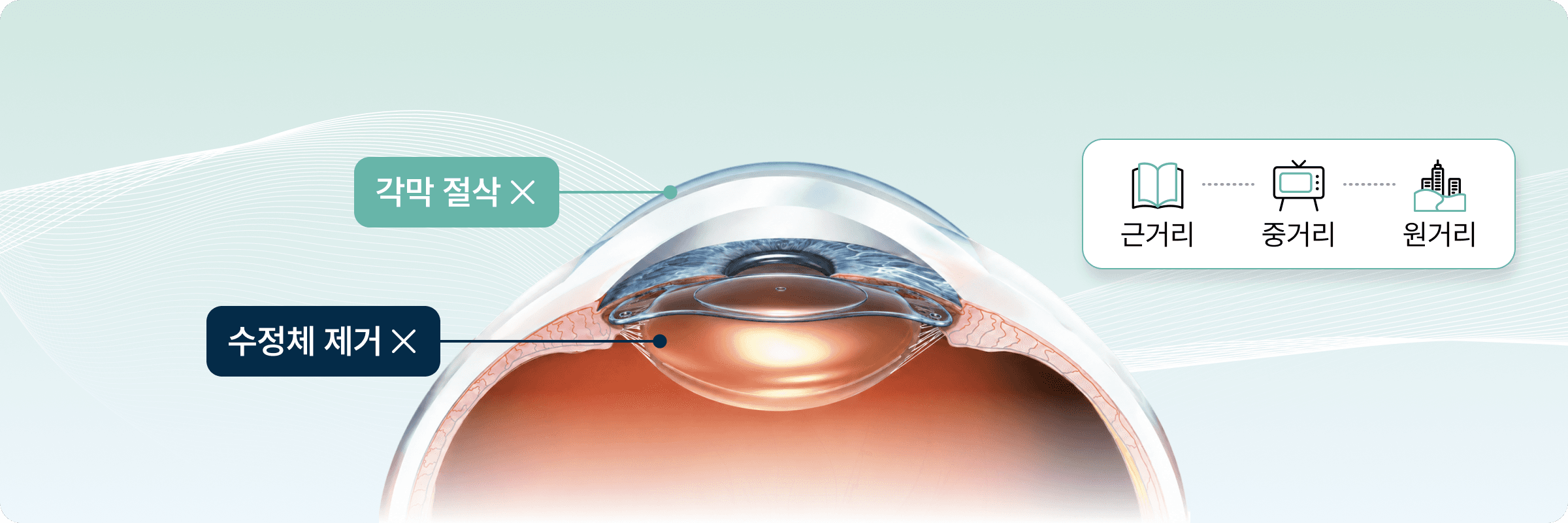
General vision correction surgeries correct myopia, hyperopia, or astigmatism to provide clear distance vision without the need for glasses or contact lenses; however, they do not treat presbyopia. For individuals who begin experiencing presbyopia after age 40, or those around age 50 who already have presbyopia, undergoing EVO+ICL surgery can provide clear distance vision, but near vision (for activities like using a PC, reading, or using a smartphone) will still require reading glasses. Just as there are bifocal glasses and contact lenses that correct both myopia and presbyopia, there are also intraocular lenses with bifocal or multifocal designs.

  • < Normal Vision >

  • < Vision with Presbyopia >

Characteristics of Typical Multifocal Lenses

Multifocal lenses are typically performed in conjunction with cataract surgery and are generally not recommended for early presbyopia or for younger individuals.

Refractive Type

Refractive Type

These lenses combine distance and near vision lenses in a concentric structure. They have a nearly identical refractive surface to monofocal lenses, allowing around 90% of distance vision, comparable to monofocal lenses. This provides comfort for driving during the day and at night or in rainy conditions.

The downside is that correction power decreases as focus shifts from distance to near, making mid-range vision (for tasks like computer use or golf) good, but near vision (20–30 cm for viewing a phone or document) may still require enlarged text or reading glasses.

Segmented Refractive Type

Segmented Refractive Type

These lenses are structured with distance and near vision lenses combined vertically. They retain the contrast sensitivity (object clarity) of the refractive type and have relatively less halo effect at night. The downside is that it can be more challenging to view mid-range and near distances, and there may be ghosting due to an increase in coma aberration, a type of irregular astigmatism.

Apodized Diffractive Type

Apodized Diffractive Type

These lenses are designed with a stepped, diffractive structure from the center outward, splitting light to provide vision at far, intermediate, and near distances. They offer the best near vision among multifocal lenses, allowing the wearer to see a smartphone without glasses. However, the divided light may reduce contrast sensitivity (clarity) and cause more halos at night, making night driving challenging. Near vision also decreases slightly in low-light conditions.

EDOF (Extended Depth of Focus)

EDOF (Extended Depth of Focus)

This type of lens extends the range over which objects remain in focus, offering clear vision from distant to intermediate ranges. Unlike other lenses that focus as a "point," EDOF lenses create a broad "line" of focus, providing a wide, natural field of view with minimal halo effects. The drawback is slightly weaker near vision compared to other lenses.

Differences Between Monofocal and Multifocal Intraocular Lenses

Multifocal lenses are generally not recommended for early presbyopia or for younger individuals.

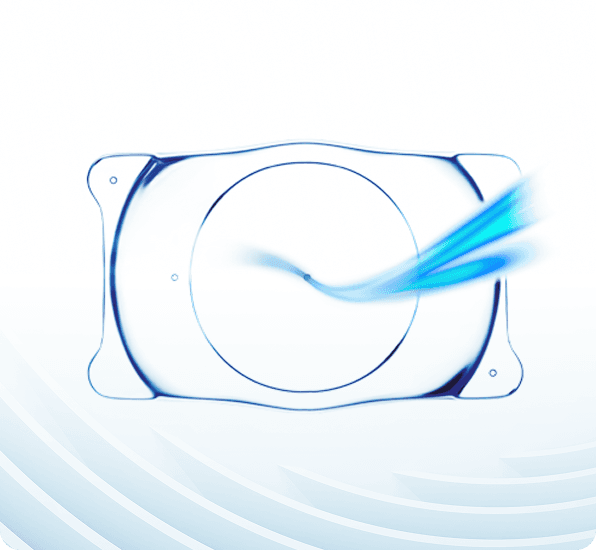
  • Monofocal Intraocular Lens (ICL)

    Monofocal Intraocular Lens (ICL)
  • Multifocal Intraocular Lens : EDOF Lens: Extends depth of focus

    Multifocal Intraocular Lens : EDOF Lens: Extends depth of focus
  • Focusing Mechanism of Apodized Diffractive Trifocal Lens

    Focusing Mechanism of Apodized Diffractive Trifocal Lens

Correcting Presbyopia (Decreased Accommodation) with Monofocal and Multifocal Lenses

For individuals experiencing early or existing presbyopia, presbyopia correction surgery can provide clear distance vision, but near vision still requires reading glasses. An alternative option is monovision with monofocal EVO+ICL lenses, where each eye is corrected slightly differently, allowing one eye to focus on distance and the other on near objects. This method, known as "micro-monovision," minimizes the difference between the two eyes to reduce discomfort. Before surgery, patients wear trial glasses with different focal points in each eye to ensure they can tolerate the adjustment. If discomfort is reported, monovision surgery may not be suitable.

Using multifocal intraocular lenses to correct both myopia and presbyopia allows for clear vision at a distance without needing reading glasses for near vision. However, multifocal lenses may provide slightly less clarity for distant objects and can be more challenging to use in dark or dimly lit environments. Choosing multifocal lenses should align with one's lifestyle.